
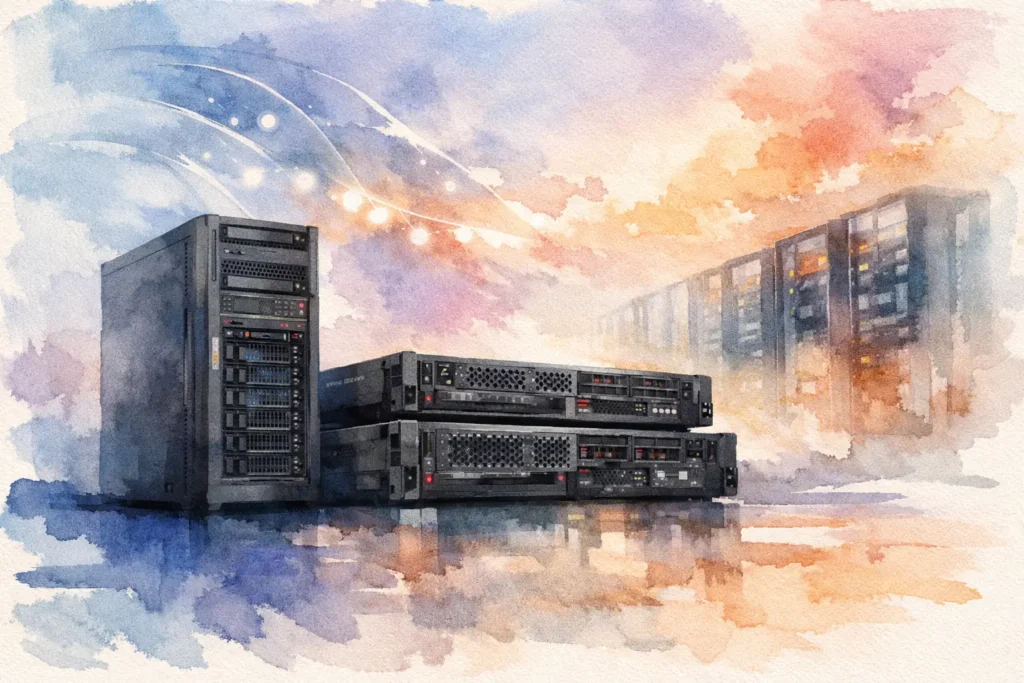
When an operation depends on critical applications, databases running throughout the day, virtualization, and continuous access from multiple locations, choosing Lenovo servers for a data center becomes more than a catalog decision. It becomes a decision about operational continuity, managing growth, and having the capacity to respond when the business demands more performance without accepting downtime.
In this setting, Lenovo has established itself as a serious option for organizations that need stable, scalable infrastructure aligned with real business requirements. It is not just about computing power. It is about building a platform that supports mixed workloads, simplifies administration, maintains energy efficiency, and enables growth without redesigning the data center every time demand changes.
Why Lenovo data center servers are gaining ground in critical environments
A modern data center no longer hosts only traditional services. Today, virtual machines, remote desktops, analytics, business applications, collaboration tools, security platforms, and, in many cases, hybrid workloads that split processing between on-premises systems and the cloud coexist. In this context, infrastructure must perform consistently.
Lenovo servers stand out by combining processing capacity, a design focused on availability, and an ecosystem built for enterprise operations. For infrastructure managers, that means less friction when consolidating workloads, better use of rack space, and a more predictable foundation for growth or technology refresh projects.
There is also a factor that often matters more than the specification sheet: the ability to integrate the server into a comprehensive strategy. Excellent hardware, without properly designed storage, networking, backup, cybersecurity and support, rarely delivers the expected results. That is why the right conversation starts with the workload the server will support, rather than the model.
What to evaluate before choosing Lenovo servers for a data center
The first question should not be how many cores the server needs, but which workloads it will support over the next three to five years. Sizing for general-purpose virtualization differs from sizing for transactional databases, VDI, ERP, or contact center platforms with high concurrency. Each scenario changes the relative importance of CPU, memory, storage, and networking.
Memory often becomes a bottleneck sooner than expected, especially in virtualized environments. Many organizations buy based on current usage and, six months later, discover that growth in virtual machines, agents, users, or security services is already straining the platform. Lenovo’s ability to scale memory and processors, depending on the product family selected, is an important consideration. However, the actual expansion ceiling should be validated from the outset to avoid limiting future growth.
Storage deserves a separate assessment. If the workload depends on low latency, drive type and access architecture matter as much as total capacity. A server with a properly sized CPU can perform poorly if its storage subsystem cannot keep up. For high-IOPS workloads, analytics, or active databases, the right combination of NVMe, SSDs, and redundancy design can completely change the operational experience.
Connectivity also shapes the outcome. An enterprise data center needs servers ready to integrate with redundant networks, appropriate segmentation, and increasingly higher speeds to prevent saturation in east-west traffic, replication, or backups. If the infrastructure will coexist with SANs, clusters, or hyperconverged solutions, this planning cannot be left until the end.
Rack, tower, or specialized nodes: it depends on the use case
Most medium-sized and large organizations choose rack servers for their data centers for density, organization, and ease of expansion. They are the natural choice when consolidating multiple services, maintaining a standardized architecture, and simplifying the physical management of the environment.
However, not every project needs the same deployment format. A company with a small equipment room or a remote operation may require more flexible form factors. Likewise, high-performance workloads, intensive virtualization, or software-defined environments may benefit from more specialized platforms.
This is where one of the most common mistakes occurs: choosing based on unit price rather than total operating cost. A seemingly cheaper server may require more space, consume more energy, complicate cooling, or fall short sooner than expected. In a data center, every technical decision has a financial consequence.
Real-world performance: beyond the specification sheet
In enterprise projects, performance is measured not only by maximum capacity but also by sustained behavior. A server may post attractive laboratory figures and still fail to perform as expected when multiple workloads, backup windows, antivirus, replication, and simultaneous access peaks overlap.
That is why it is worth considering real-world scenarios. A banking environment, for example, prioritizes stability, fault tolerance, and consistent response. A BPO or contact center may need high user density, integration with telephony, recording, analytics, and continuous availability. In education or government, workloads may vary seasonally, but service must remain stable for hundreds or thousands of users.
Lenovo offers platforms capable of performing well in these environments, but the final result depends on the overall design. If concurrency, expected growth, and the high-availability policy are not calculated correctly, even a good server can be poorly utilized.
Security, resilience, and management
Today, it is not enough for a server to work. It must be manageable, auditable, and resilient to operational and cybersecurity incidents. This includes access controls, remote management capabilities, hardware health monitoring, preventive alerts, and a clear firmware and update strategy.
In environments with continuity requirements, it is also essential to review redundancy in power supplies, cooling, storage, and connectivity. High availability is not an isolated server attribute, but it starts with a platform designed to operate through partial failures without compromising service.
Remote management becomes especially valuable when there are multiple locations, small internal teams, or a need for a rapid response outside business hours. Being able to diagnose, intervene, and escalate incidents without always requiring physical access improves resolution times and reduces operational impact.
The local factor: implementation and support matter as much as the hardware
In the Dominican Republic, many infrastructure decisions succeed or fail after the purchase. The hardware may be right, but if implementation is delayed, migration assistance is unavailable, or support does not understand the customer’s environment, the project starts creating risk from day one.
That is why, when evaluating Lenovo servers for a data center, it is worth examining who designs the solution, who installs it, and who supports it throughout its useful life. This is precisely what separates a purchase from a solution. A partner with local experience can align capacity, security, virtualization, backup, and monitoring within a single architecture, avoiding isolated decisions that later increase operating costs.
That support is even more important when the server is part of a broader modernization effort: infrastructure consolidation, storage renewal, stronger cybersecurity, hybrid cloud deployment, or expansion of customer service platforms. In those cases, the infrastructure must fit within a broader operational vision.
When Lenovo is a particularly good fit
Lenovo is often a good fit for organizations seeking a balance of performance, scalability, and operational efficiency. It is an appealing option for companies that want to standardize their platform, improve compute density, and support growth without overprovisioning from day one.
It is also suitable when the priority is to consolidate multiple services onto fewer systems, with centralized management and a reliable foundation for virtualization. In operations with continuous demands, that combination helps control costs, simplify maintenance, and reduce points of failure.
That said, the highest configuration is not always the best choice. Some projects benefit from a phased design with defined expansion capacity rather than an excessive initial investment. In others, critical workloads justify moving directly to a more resilient architecture. The right answer depends on acceptable risk, the pace of growth, and the financial impact of an interruption.
A decision that affects the business, not just IT
Whenever an organization redefines its server platform, it is making a decision that affects productivity, customer experience, compliance, and its ability to scale. The assessment should therefore take a business perspective, rather than rely solely on isolated technical criteria.
For a company operating critical services, the useful question is not whether the server meets today’s needs, but whether it will enable controlled growth, protect operations, and maintain consistent service levels. That is where a thorough evaluation makes the difference.
When infrastructure is thoughtfully designed, the data center stops being a constant concern and becomes a reliable foundation for moving faster with less risk.
Related articles
Dell hardware for businesses: what to choose · Server monitoring: coverage and scope
Ready to take the next step?
At ITGenics, we help you select and implement Lenovo servers and equipment for your business in the Dominican Republic. Explore our Lenovo solution →