
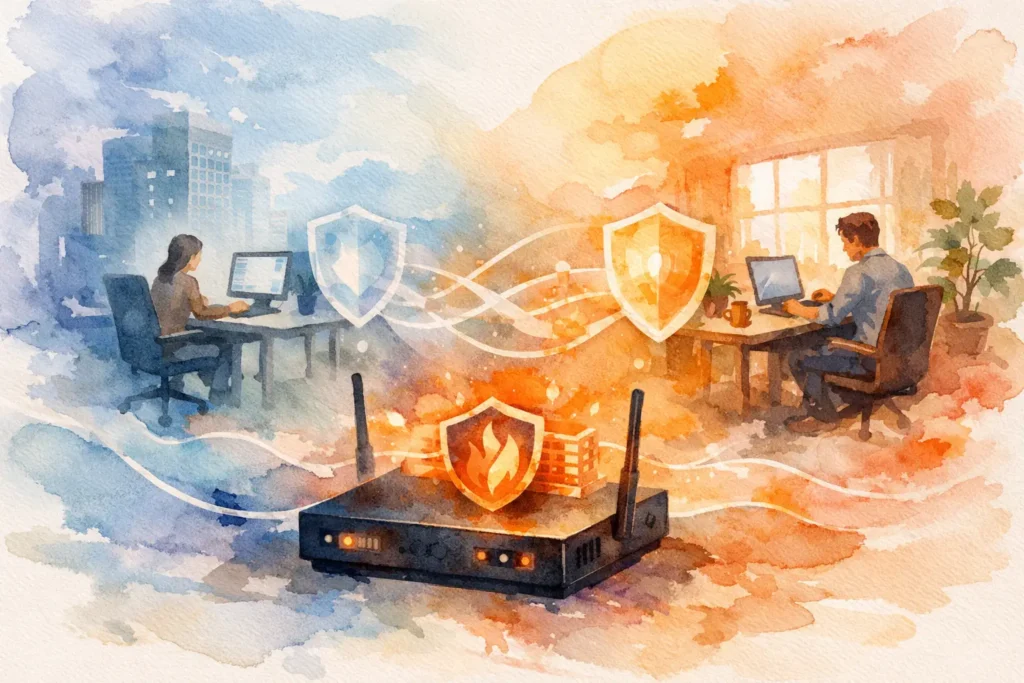
When a team works three days at home, two in the office, and also connects from different locations, the network is no longer a fixed perimeter. This is where a managed firewall for hybrid offices becomes an operational decision rather than just a technical purchase. It is about more than blocking threats. It is about maintaining control, visibility, and continuity in an environment where users, devices, and applications are no longer in one place.
Many organizations have experienced this shift the costly way: an overloaded VPN, poorly segmented remote access, personal devices connecting to critical systems, or inconsistent security policies across branches. In a hybrid model, every exception adds to accumulated risk. That is why more companies are moving from reactive administration to a managed service that combines technology, monitoring, and continuous response.
How to contract a managed firewall service in the Dominican Republic
Before requesting a quote, prepare the number of users, locations, and remote connections, connection speeds, critical applications, and your current firewall model. These details allow the required capacity to be assessed and equipment, licensing, and service management costs to be separated.
- Scope: document which locations, devices, rules, VPNs, and services are covered.
- Support: agree on hours, incident priorities, escalation, and response times. 24/7 monitoring and technical intervention must be specified separately.
- Maintenance: define configuration backups, rule reviews, renewals, and update windows.
- Control: request reports, designated approvers, and an exit procedure that allows you to retrieve your configurations.
ITGenics can review your Fortinet enterprise firewall project and the scope of managed services you need. Request a managed firewall assessment and quote with details of your users, locations, and support needs.
What a managed firewall solves for hybrid offices
The issue is not just traffic entering and leaving the main office. The real challenge is that several attack surfaces now coexist: remote users, cloud applications, connections between locations, mobile devices, collaboration platforms, and third-party access. If security is still designed as though everything were inside one local network, blind spots emerge.
A managed firewall for hybrid offices allows consistent policies across environments, access control by user or profile, traffic inspection, content filtering, detection of unusual behavior, and traceability. The difference lies in the word managed. The platform alone does not guarantee protection if no one reviews events, adjusts rules, validates false positives, or responds to incidents outside business hours.
In companies with continuous operations, such as BPOs, contact centers, banking, education, or critical services, that management layer makes a concrete difference. A security failure affects more than IT. It also affects productivity, customer experience, compliance, and reputation.
The most common mistake: buying equipment without managing the service
It is common to find organizations using a good security vendor but relying on inherited policies, duplicate rules, and undocumented changes. The consequences are not always visible on day one. In fact, many networks appear to work well until an outage, intrusion, or service degradation occurs.
Hybrid security requires ongoing review. Users change, applications evolve, and risks change too. A firewall can be correctly implemented and still become misaligned with the business within a few months if no one operates it thoughtfully. The most efficient approach is therefore often to combine appropriate technology with specialized management, monitoring, and support.
This also has a financial implication. For many companies, training and retaining specialized talent in perimeter security, remote access, segmentation, and incident response costs more than outsourcing operations under clear service agreements. Keeping everything in-house is not always best. It depends on team size, criticality, and internal maturity.
What a well-managed solution should include
Not every proposal labeled a managed service offers the same coverage. Some are limited to initial configuration and on-demand support. Others truly operate security as an ongoing business function.
In a hybrid environment, it is advisable to require at least policy administration, 24/7 monitoring, alert management, firmware updates, incident support, performance reviews, remote access control, and executive reports. The solution should also account for segmentation between departments, prioritization of critical applications, and room to grow as new locations open or the remote workforce expands.
Visibility is another sensitive issue. A technology director needs to know what is happening and translate it into operational impact. Receiving logs is not enough. Events must be interpreted, trends identified, and decisions made before problems escalate.
Managed firewalls for hybrid offices and business continuity
When connectivity supports sales, customer service, financial operations, or academic platforms, security cannot operate separately from continuity. An undersized or poorly managed firewall can become a bottleneck. A well-managed one helps sustain operations.
This is especially evident in organizations with multiple locations or users connecting through VPN, SD-WAN, or cloud applications. Proper management allows critical traffic to be prioritized, unauthorized services restricted, exposure reduced, and a stable end-user experience maintained. Security and performance do not always compete, but they must be balanced thoughtfully.
That balance matters. An overly permissive policy increases risk. An overly restrictive one can affect productivity, video calls, softphones, or access to essential platforms. The best configuration is not the most aggressive, but the one that reflects the company’s actual circumstances.
How to assess whether your company needs it now
There are clear signs. If your team depends on remote access, locations are interconnected, or you use Microsoft 365, cloud business applications, or intensive collaboration tools, complexity has already outgrown the traditional basic firewall model. The same applies if internal IT spends too much time on operational incidents instead of strategic work.
It is also worth checking for recurring problems such as VPN tunnel outages, slow critical applications, rules no one dares to change, a lack of clear reports, or no monitoring outside business hours. These situations often indicate that security infrastructure is running by inertia rather than under active control.
For regulated sectors or organizations with substantial sensitive data exposure, waiting for an incident is not a reasonable option. The question is no longer whether a managed layer is needed, but which service level and architecture best fit operations.
What to look for in a technology partner
In projects of this kind, the provider should do more than install an appliance. It must understand operations, identify critical dependencies, and align security with business objectives. This includes evaluating connections, topology, remote users, applications, anticipated growth, and compliance requirements.
A good partner also brings local delivery capabilities, specialized support, and knowledge of the Dominican business environment. This practical component is often decisive when coordinating deployments across branches, integrating leading brands, or responding quickly to an incident. A close business relationship helps, but the real difference lies in the ability to operate with technical discipline.
In this setting, ITGenics supports organizations that need to integrate cybersecurity, connectivity, and infrastructure under a single service model, with a focus on operational continuity and ongoing protection. This model is especially useful when a company wants to simplify management without losing control.
The human factor remains decisive
Even with an advanced firewall and a well-designed service, hybrid security never depends on technology alone. Policies must be backed by internal governance, access control, privilege reviews, and an operational culture. A user with excessive permissions or a poorly segmented third party can create a gap that no console can fix on its own.
The right conversation is therefore not simply about which firewall to buy. It is about how to protect hybrid operations with a sustainable, measurable model aligned with the pace of the business. Some companies will only need to strengthen their current architecture. Others will need to redesign access, segmentation, and monitoring from the ground up.
That is precisely the value of a managed service: turning a technical tool into an ongoing capability. When the network no longer ends at the office, security should not end there either.
The best decision usually reduces complexity without sacrificing visibility. If your organization depends on distributed users, critical applications, and constant availability, reviewing your firewall strategy now can prevent far more than an incident. It can give operations the control needed to grow with less friction and better judgment.
Related articles
Enterprise network security: what it requires today · How to implement enterprise zero trust · Fortinet firewalls for businesses: what they offer
Ready to take the next step?
At ITGenics, we help you implement Fortinet solutions in the DR for your business in the Dominican Republic. Explore our solution →
