
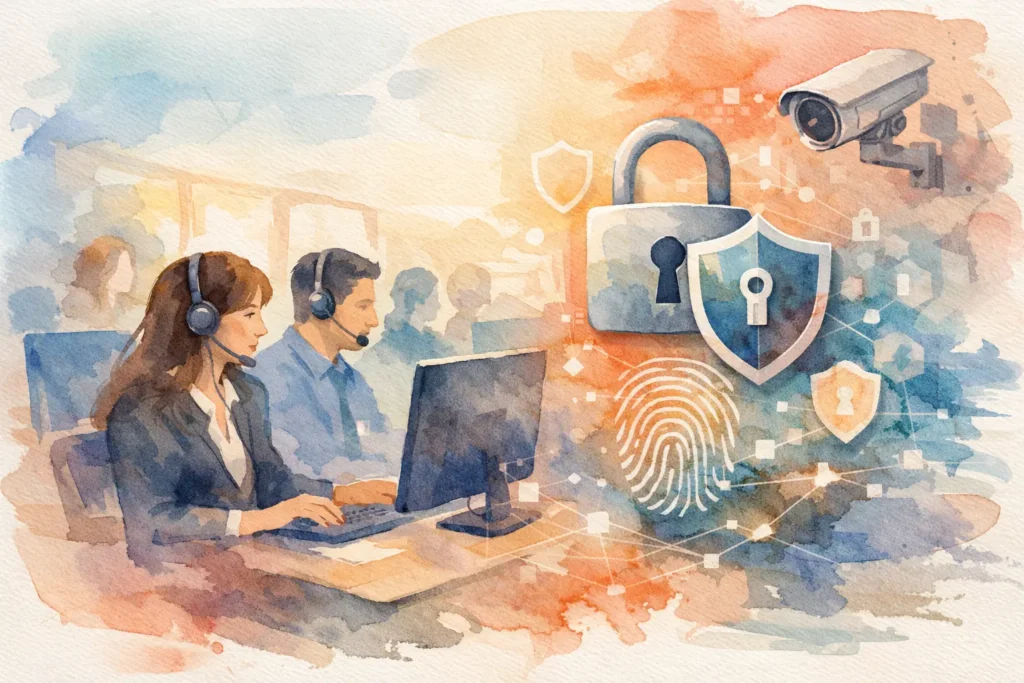
A call center can lose more in one hour of downtime than in months of poorly planned technology investment. When calls, personal data, recordings, remote access, and multiple platforms are managed at once, understanding how to protect a call center becomes more than an isolated technical matter: it becomes an operational and financial decision.
In BPO and contact center environments, risk does not come from a single source. It comes through the network, endpoints, human error, misconfigured integrations, and providers that do not maintain the same level of control. Effective protection therefore cannot be achieved by installing antivirus or a firewall once. It is built through architecture, visibility, and ongoing response capabilities.
How to protect a call center based on its actual operations
The first sound decision is to recognize that a call center does not operate like a conventional office. It has higher user turnover, greater pressure for availability, more dependence on voice, and more exposure involving credentials, recordings, sensitive data, and cloud tools. This requires designing security around operations, rather than the other way around.
If a measure blocks agent productivity, it will probably be misused or bypassed entirely. If a policy allows too much freedom, risk rises sharply. The balance lies in applying controls that reduce the attack surface without affecting response times, service quality, or continuity.
The network must be segmented, not just protected
Many contact centers still operate flat networks in which agent workstations, servers, IP telephony, printers, and administrative systems share too much space. This design makes it easier for an incident to spread laterally. A compromised device should not have an unrestricted path to critical platforms, recording environments, or databases.
Segmenting the network makes it possible to isolate services, define policies by traffic type, and limit the impact of an intrusion. Voice, for example, requires priority, stability, and dedicated monitoring. Management systems, supervision tools, and third-party access should reside in separate segments with clear communication rules.
There is an important nuance here: poor segmentation also creates problems. If implemented without understanding business workflows, it can introduce latency, integration failures, and lower service quality. That is why it is best to begin with an analysis of actual traffic, rather than a generic template.
Identity is the new perimeter
When part of the operation works remotely, uses virtual desktops, or accesses cloud voice and customer service platforms, the traditional perimeter is no longer enough. Protection increasingly depends on who is accessing resources, from where, with which device, and under what conditions.
Multifactor authentication should no longer be up for debate for administrative access, security consoles, corporate email, and critical contact center platforms. Privileges should also be reviewed. In many environments, users accumulate permissions through role changes, operational emergencies, or simple oversights. This increases the potential damage from credential theft.
The principle of least privilege reduces exposure, but it requires governance. Reducing access without a clear process can slow support, supervision, and management. The practical solution is to combine well-defined profiles with regular reviews and automated onboarding, offboarding, and changes.
Protecting call center endpoints
In a call center, the endpoint is no minor detail. It is where the agent, the customer conversation, and access to sensitive information come together. Every workstation, laptop, or thin client should be considered a critical asset, especially in hybrid operations or distributed campaigns.
Effective protection starts with device hardening, USB port control, centralized patch management, and the ability to detect unusual behavior. Installing tools is not enough; teams must confirm that they are updated, report correctly, and are not being disabled by users or incompatibilities.
A common tension arises here: the stricter endpoint controls become, the more likely they are to affect the agent experience. Policies should therefore be defined according to usage profiles. A supervisor, an administrator, and an agent should not have the same exposure level or the same restrictions.
Voice, recordings, and data: the most underestimated asset
Many business leaders protect networks and equipment well but leave gray areas in the voice layer. Yet a call center depends on telephony, recordings, interaction metadata, and integration with CRM, ERP, or service platforms.
Protecting this environment involves encrypting communications where appropriate, controlling access to recordings, logging administrative activity, and reviewing integration security. Recordings contain sensitive information, and their value is not only operational or legal. They are also attractive targets for extortion, fraud, or data leaks.
Not every call center needs the same retention period or storage model. This depends on the industry, regulatory framework, and campaign type. The important thing is to avoid decisions made out of habit, such as storing everything indefinitely or allowing broad access to supervisors and third parties.
How to protect a call center against human error
Most incidents do not begin with a sophisticated technique. They begin with a click, a reused password, an unattended session, or a procedure improvised under operational pressure. In an environment with high turnover and demanding metrics, this risk increases when security is presented as an obstacle.
Training works best when connected to real situations employees face: phishing emails targeting supervisors, HR-related impersonation, fraudulent remote access, fake password reset requests, or data extraction through unauthorized channels. Generic awareness training rarely changes behavior.
Processes should also be reviewed. If agents need to find shortcuts outside the procedure to resolve an issue, that clearly signals a poorly designed control. Useful security reduces friction without sacrificing traceability.
Continuous monitoring and rapid response
A call center cannot afford late detection. When an incident affects customer service, the impact quickly reaches SLAs, reputation, revenue, and the customer experience. Monitoring must therefore combine network, identity, endpoint, email, cloud, and telephony events into a correlated view.
Isolated visibility offers little value. What matters is connecting signals: an unusual login, an unexpected download, a privilege change, strange device behavior, and a suspicious pattern on the voice platform. This correlation shortens response times and prevents analysis from relying solely on manual review.
The managed IT services can complement the internal team with maintenance, support, and follow-up within the contracted scope. ITGenics does not offer SOC services. If your operation requires that coverage, it must be contracted through a specialized provider.
Business continuity: protection also means staying operational
Discussing security without continuity leaves the job half done. A call center must assume it could experience connectivity failures, power incidents, configuration errors, platform outages, or cyberattacks. The real question is not whether these can happen, but how long the center can withstand them without disrupting operations.
This requires redundant connectivity, backup power, tested backups, failover procedures, and defined scenarios for alternative ways of working. Having a backup does not guarantee recovery. If restoration is not tested, estimated recovery time is often more optimistic than reality.
Continuity also requires priorities. Not every service needs to be restored at the same time. Identifying which platforms sustain customer service, which can wait, and how they depend on each other prevents improvised decisions during a crisis.
The role of the technology partner
Protecting a call center requires combining infrastructure, cybersecurity, collaboration, cloud, telephony, and operational support. When these elements are managed separately, gaps in responsibility, slow diagnoses, and decisions that improve one component at the expense of the whole can emerge.
That is why many organizations are moving toward an integrated partner model, with the ability to design, implement, monitor, and adjust the architecture to operational realities. In markets where local response speed matters, a partner with hands-on local delivery and business understanding offers a clear advantage. This approach is especially useful in modernization projects, migration to cloud platforms, and managed security, such as those ITGenics develops for highly critical enterprise environments.
Effective protection is not about accumulating tools. It is about aligning technology, processes, and support so the call center can grow without its exposure increasing at the same pace. When security is designed with operations in mind, it becomes more than a defensive expense: it provides a real foundation for continuity, control, and confidence.
Related articles
Enterprise network security: what it requires today · Cybersecurity for Businesses in the Dominican Republic: Complete Guide 2025
Ready to take the next step?
At ITGenics, we help you implement Chattigo and a cloud contact center for your business in the Dominican Republic. Explore our solution →
